



July 17, 2021
Here is an article about the Moon wobble and how NASA got it so very wrong.
From the article:
The moon, yes. Climate change, no!
This moon’s wobble (also called lunar standstill) shifts approximately every 18.6 years. The moon is currently in a cycle in which high tides are lower and low tides are higher than average, but this is about to change.
NASA reports the moon is approaching a shift in its nodal cycle, which will amplify high tides, making them higher, as well as making low tides lower.
This will contribute to more nuisance flooding beginning around 2030 and lasting for possibly more than a decade. This cyclic shift would happen regardless of any contribution humanity might be making to sea-level rise.
While NASA and the media covering its report claim that climate change enhanced sea-level rise will exacerbate the flooding, data does not support this.
As explored in Climate at a Glance: Sea Level Rise,tide gauge data proves average global sea levels have been rising at a relatively steady pace of approximately one foot per century since at least the mid-1800s.
And data from satellites confirm there has been very little recent acceleration in sea-level rise. Assuming all of the modest increase in sea-level rise is due entirely to alleged human-caused global warming, that amounts to an acceleration of only 0.3 inches of sea-level rise per decade on top of the preexisting 1.2 inches of sea-level rise per decade. [See the image]
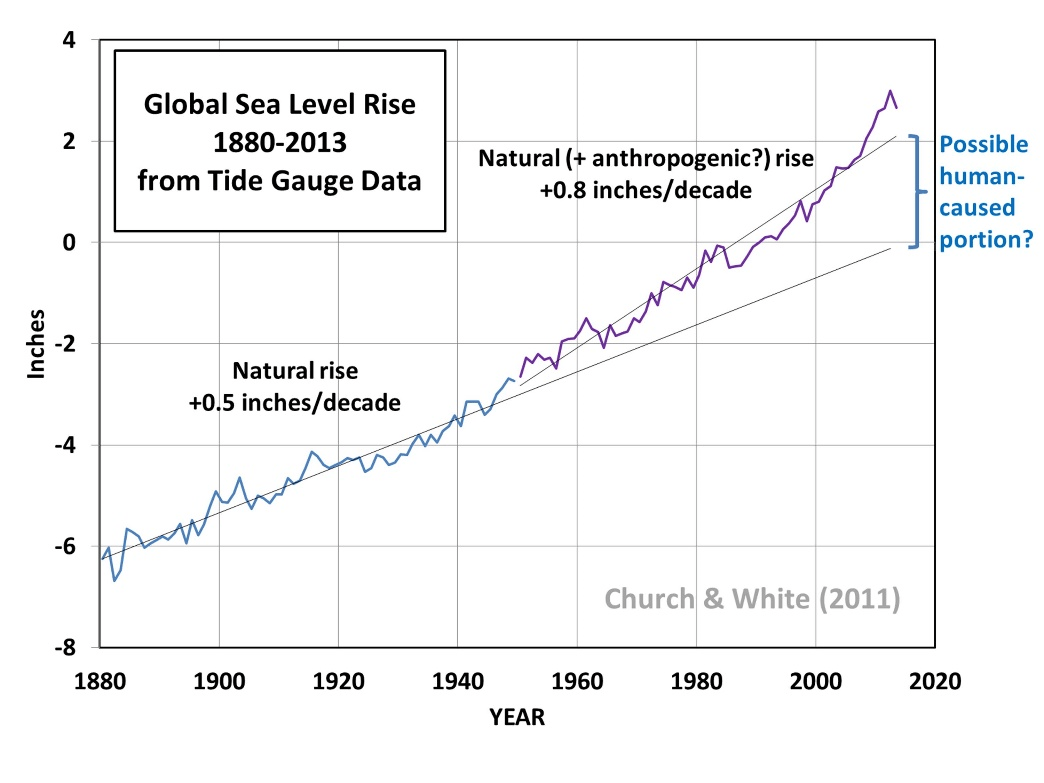
Figure 1: (click to enlarge) This figure shows sea-level rise dating back to the late-1800s. The very modest recent increase, even if it is due entirely to humans, adds up to merely 0.3 inches per decade of added sea level rise. Source: Church, J.A. & White, N.J. Surveys in Geophysics (2011) 32: 585: https://doi.org/10.1007/s10712-011-9119-1. Graph by Dr. Roy Spencer.
With at most a third of an inch contribution to rising seas by 2030, climate change won’t be a significant contributor to any increased flooding that occurs when the moon’s wobble shifts to a new cycle.
NASA uses wordplay, or in this case, time-shifting, to make it seem climate change will play a significant role in high tide flooding when the moon’s wobble shifts around 2030.
The paper’s main discussion focuses on the impact of the moon’s shift on flooding in the 2030 to 2040 time period. However, when climate change’s contribution to sea-level rise is discussed, NASA shifts to discussing the National Oceanic and Atmospheric Administration’s (NOAA) estimates of sea-level rise in 2100.
Posted by: Timothy Birdnow at
08:30 AM
| Comments (1)
| Add Comment
Post contains 443 words, total size 6 kb.
37 queries taking 0.5244 seconds, 186 records returned.
Powered by Minx 1.1.6c-pink.

