



July 23, 2020
Dr. John Iaonidis says Wuhan is a once-in-a-lifetime data failure.
From the article:
The answer surprised reporters, who probed for additional information.
"He died in a motorcycle accident,†Dr. Raul Pino clarified. "You could actually argue that it could have been the COVID-19 that caused him to crash. I don’t know the conclusion of that one.â€
The anecdote is a ridiculous example of a real controversy that has inspired some colorful memes: what should define a COVID-19 death?
While the question is important, such incidents may be just the tip of the proverbial iceberg regarding the unreliability of COVID-19 data.
In May, a public radio station in Miami broke what soon became a national story. The US Centers for Disease Control and Prevention (CDC) had been conflating antibody and viral testing, obscuring key metrics lawmakers use to determine if they should reopen their respective economies.
The story was soon picked up by NPR, who spoke to an epidemiologist who condemned the practice.
"Reporting both serology and viral tests under the same category is not appropriate, as these two types of tests are very different and tell us different things," Dr. Jennifer Nuzzo of the Johns Hopkins Center for Health Security told NPR.
The Atlantic soon followed with an article that explained the agency was painting an inaccurate picture of the state of the pandemic. The practice, the writers said, was making it difficult to tell if more people were actually sick or had merely acquired antibodies from fighting off the virus.
Read the whole article.Also, read this article about the horrendous nature of the models and how they have gotten it wrong from the beginning.
In both of these reopening scenarios, the model depicted a catastrophic rebound of COVID-19 fatalities. As the ICL team itself put it, their model "illustrates the potential consequences of increasing mobility across the general population: in almost all cases, after 8 weeks, a 40% return to baseline [mobility] leads to an epidemic larger than the current wave.†Media reportsat the time touted the study’s dire warnings as reasons to stall the reopening process – even at its sluggish pace of recurring 2-week delays and extensions.
More than 8 weeks have passed since the publication of the ICL team’s warnings against reopening, meaning we can now see how their model performed.
As with other examples of ICL COVID modeling, their attempt to predict the effects of a US reopening can only be described as an embarrassing scientific failure.
The image below shows the three modeled scenarios from May, as depicted in the ICL report for the five states under consideration. Note that even under the "constant mobility†scenario of remaining under lockdown, their model predicted an increase in COVID deaths for every state except New York, which had already peaked. Under the reopening scenarios where mobility increased 20% and 40% respectively from its lockdown state, all five states were predicted to surge into apocalyptic territory by the middle of July. Under the 40% scenario, this even entailed upper boundaries of more than 4,000 deaths per day (the bands represent the 95% confidence interval). Massachusetts and New York, two of the hardest-hit states from the first wave back in March and April, would easily match or exceed their previous COVID-19 daily death records.
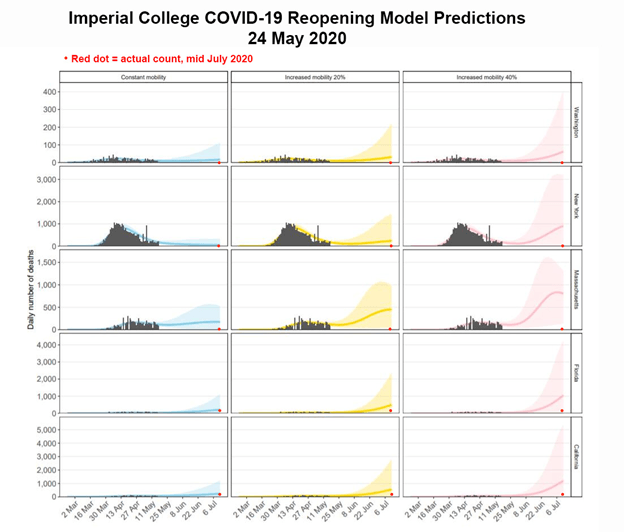
To see how these predictions held up, I indicated the daily death totals for each state for July 20th with a small red dot on the graphs above. As you can see, the actual totals are below the ICL model’s predictions in every scenario. In Massachusetts, the current daily death totals are even falling below the lower boundary of the ICL model’s projections for both its 20% and 40% mobility increase scenarios.
Coronavirus cases and deaths have spiked in two of the modeled states, Florida and California. As of the week of July 20th, both are averaging between roughly 100 and 150 deaths per day. Yet even with this "second wave†spike, Florida and California are only showing about one-tenth of the projected deaths that the Imperial College modelers predicted for this time back in May.
In New York, Washington, and Massachusetts, daily death counts have dropped to the low double-digits and remain a tiny fraction of the ICL predictions for mid-July.
Although all five states remain under COVID-19 restrictions of varying degrees, even partial reopening has increased mobility at levels that match or exceed the ICL’s modeled scenarios. The main Google mobility indicators for Massachusetts are depicted below for reference, and show a clear upward trend since the time of the ICL predictions in mid-May.
Posted by: Timothy Birdnow at
12:09 PM
| Comments (2)
| Add Comment
Post contains 811 words, total size 8 kb.
But yes, the virus caused the motorcyclist to crash? Good golly, Miss Molly! I knew motorcycles could be dangerous if you didn't know your stuff, but THAT dangerous? Wow!
Posted by: Dana Mathewson at July 23, 2020 10:05 PM (DJw/m)
I guess there was a glitch in the posting; I'll fix it.
Posted by: Timothy Birdnow at July 24, 2020 07:00 AM (0CCNP)
37 queries taking 0.2115 seconds, 190 records returned.
Powered by Minx 1.1.6c-pink.

